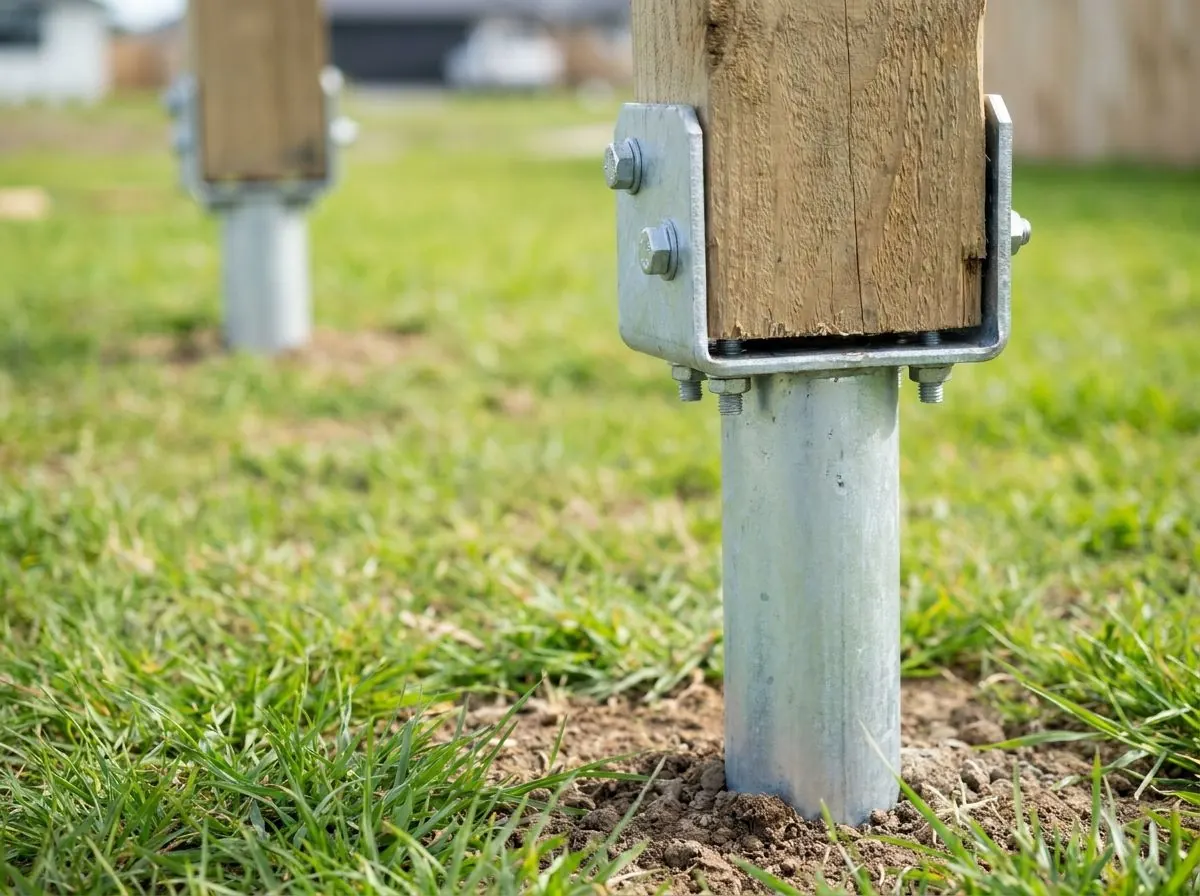
Screw Piles for Fence Posts and 6×6 Posts
Small job, same physics. A fence post set in concrete in Calgary clay is a textbook frost heave candidate, and most people find that out in year three.
Why posts heave here
Two things happen to a concreted post over a winter.
Water in the soil around it freezes and expands, gripping the sides of the concrete plug and lifting it — this is adhesion freezing, and it is why a post can rise even when the base sits below frost depth.
Then the clay itself moves. Calgary’s high-plasticity clay swells when wet and shrinks when dry, and a post in the top metre rides that cycle.
The result is a fence line that has gone wavy, gates that stop latching, and pergola posts that are no longer the same height as each other.
A concrete plug does not prevent this. In some ways it makes a better handle for the frost to grab.
Why a helical pile behaves differently
A screw pile has a narrow shaft and a helix bearing well below the active zone. There is much less surface for frost to grip, and the helix resists uplift directly — which is the exact load frost heave applies.
That combination is why piles are specified for structures where staying level matters more than the load being carried.
When it is worth it
Worth it:
- Gate posts, where a few millimetres of movement stops the latch working
- Pergolas and shade structures, where posts must stay in plane
- Fence lines on visibly reactive clay, or where a previous fence has already moved
- Anywhere sitting on fill of unknown quality
- Sign posts and light standards that need to stay plumb
Probably not worth it:
- A long run of ordinary residential fence on good ground, where the cost per post multiplies quickly
- Temporary structures
- Anything where a bit of seasonal movement genuinely does not matter
We are not going to pretend a 60-metre fence line is a sensible pile job. For the four posts holding a gate and a pergola, it often is.
How the post attaches
A bracket at the pile head takes the timber. The common types:
- Fixed head — a plate or saddle the post bolts into
- Adjustable head — threaded, so height can be fine-tuned after installation
- Post saddle — a U-bracket sized for the timber, typically 4×4 or 6×6
Adjustable heads are worth the small extra on anything where posts must line up precisely, which is most pergola and gate work. Getting all four heads to the same elevation with a laser is far easier than shimming afterwards.
6×6 posts specifically
A 6×6 needs a bracket sized for it — a 4×4 saddle will not do, and packing it out with timber offcuts is not a fix. Say the post size when you ask for a quote and the right head comes with the pile.
The realistic cost view
Per post, a pile costs more than a bag of concrete. What you are buying is that the gate still latches in five years.
On a gate or a pergola that is usually an easy call. On a hundred metres of fence it usually is not, and we will say so.
Ask us about a small job — we do them, and we will tell you when concrete is the sensible answer instead.
Need a foundation quote?
If you have a question about a foundation or want a quote, our team is ready to help. We serve Calgary and the surrounding communities.