What Screw Piles Cost in Calgary
A screw pile quote is not one number — it moves with pile size, how deep the ground makes you go, access, and whether the permit needs engineering. This page explains each of those so you can read any quote you are given, ours included, and tell whether it is reasonable.
For your specific job we will put a firm figure in writing, usually inside 48 hours.
Send us the dimensions, get a firm number
Deck size, garage footprint or drawings — whatever you have. Most quotes come back within 48 hours, and the number we give you is the number you pay unless the ground turns out different from what we expected. If that happens, we tell you before we carry on, not after.
Get a quoteWhat Drives the Price
Six things move a screw pile quote up or down. If a contractor cannot explain which of these applies to your site, that is worth noticing.
Pile diameter and helix count
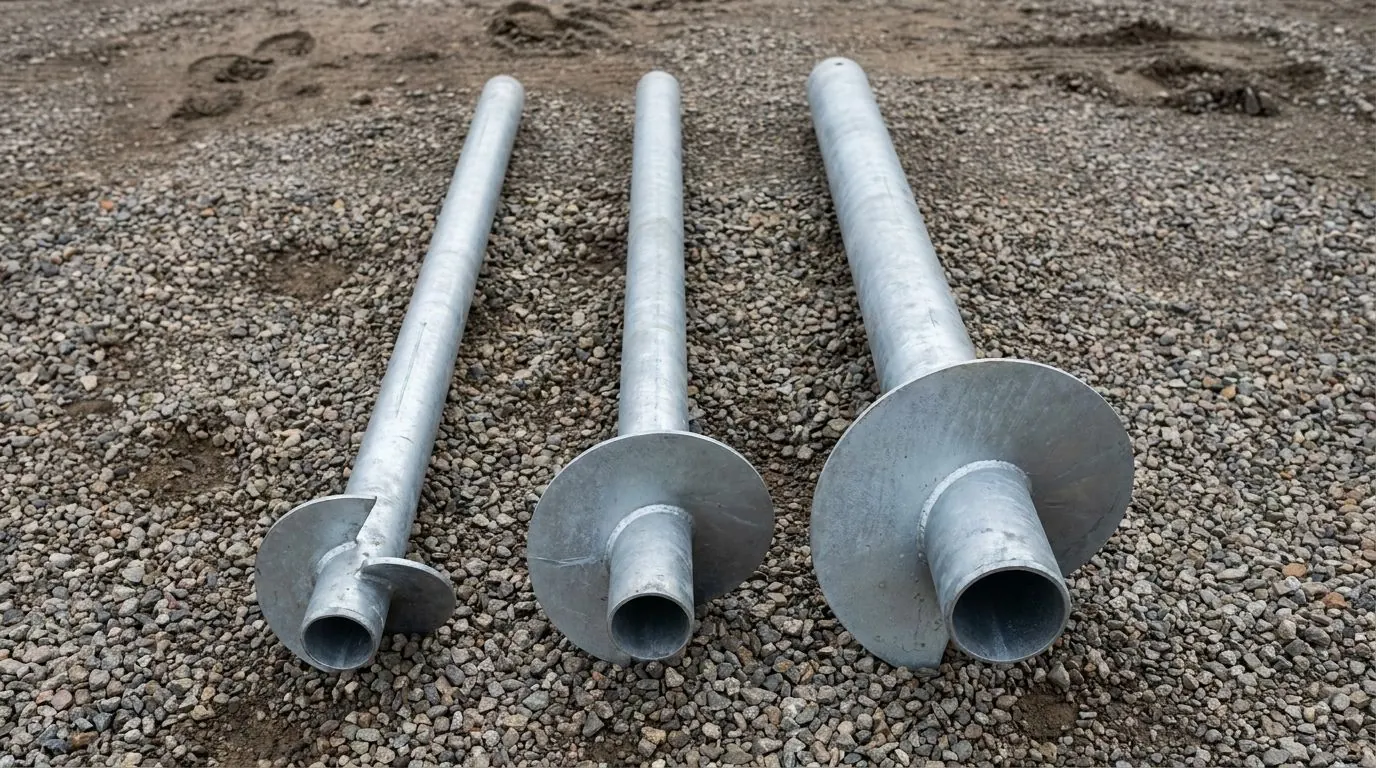
A deck pile and a pile carrying a grade beam are different pieces of steel. Bigger shaft, more helices, higher cost per pile — and fewer piles needed.
Depth to competent soil
Piles are driven until torque confirms capacity, not to a fixed depth. Ground that gives up competent strata early costs less than ground that does not.
Soil type
Calgary clay, Cochrane glacial till and cobbles, and river-valley alluvium south of the city all behave differently. Till and cobble need more torque and heavier steel.
Site access
Open lots take a tracked machine. Tight inner-city yards, fenced backyards and interior work take smaller or handheld equipment, which is slower.
Engineering requirement
Some jobs need drawings and load calculations stamped by an APEGA-licensed P.Eng. for the permit. Some do not. We tell you which before you commit.
Mobilization
We do not charge travel anywhere in our service area. Remote or winter-access sites outside it are quoted separately.
What's Included — and What Isn't
In every quote
- Utility locates coordination
- Engineered pile sizing for your load and soil
- Installation to verified torque
- Torque log and capacity documentation
- Standard caps and brackets
- Site cleanup — no spoil pile left behind
Quoted separately
- APEGA-stamped drawings where a permit requires them
- Permit application fees
- Custom fabrication or non-standard brackets
- Excavation, demolition or removal of an existing foundation
- Work outside the stated service area
Listed here so they are never a surprise on an invoice. If any apply to your job, they appear on the quote before you agree to anything.
Screw Piles vs Concrete on Cost
On materials alone, poured concrete piles often look cheaper. That comparison usually leaves things out.
Concrete needs excavation, and excavation means spoil that has to go somewhere, forms, and a machine on your lawn. Then it needs to cure — typically several days before you can build on it, longer in cold weather. Screw piles go in and carry load the same day, with no hole and no spoil pile.
Where concrete tends to win is very large pile counts on wide-open sites with easy access. Where screw piles win is tight access, winter work, small-to-medium jobs, and anywhere a few days of curing would stall the rest of your build.
We will quote you honestly on which one suits your project. If concrete is the better answer for what you are building, we would rather tell you than sell you piles.
When You Don't Need Screw Piles
A ground-level deck under 600 mm that is not attached to the house often does not need engineered piles at all. Small sheds can frequently sit on skids or a gravel pad. Shallow bedrock close to the surface sometimes makes a different foundation the sensible choice.
We will say so when that is the case. Telling you that you do not need us costs one quote and earns the next call.
Permit thresholds differ between the City of Calgary and the surrounding towns and counties — confirm with your authority having jurisdiction before you build.
Frequently Asked Questions
How deep do screw piles need to go in Alberta?
Are screw piles cheaper than concrete?
What are the downsides of screw piles?
Can screw piles be installed in winter?
Get a real number for your job
Send dimensions or drawings and we will come back with a firm quote, usually within 48 hours. No travel charge anywhere in Calgary and southern Alberta.
Not ready to quote? See how deck foundations work.