Slab Jacking & Concrete Lifting in Calgary
Lifting settled concrete — garage pads, walkways, driveways and patios — back to level without replacing the slab.
Our Slab Jacking & Concrete Lifting Process
Every job follows a clear, proven process so you know exactly what to expect from start to finish.
Quote
Send dimensions or drawings. Most quotes come back inside 48 hours.
Site visit
We confirm access, soil expectations and layout before scheduling.
Engineering
Stamped drawings and load calculations where the permit requires them.
Install
Piles driven to engineered torque. Most residential jobs take half a day.
Torque log
You receive the torque record, verified capacity and as-built documentation.
What slab jacking & concrete lifting actually involves
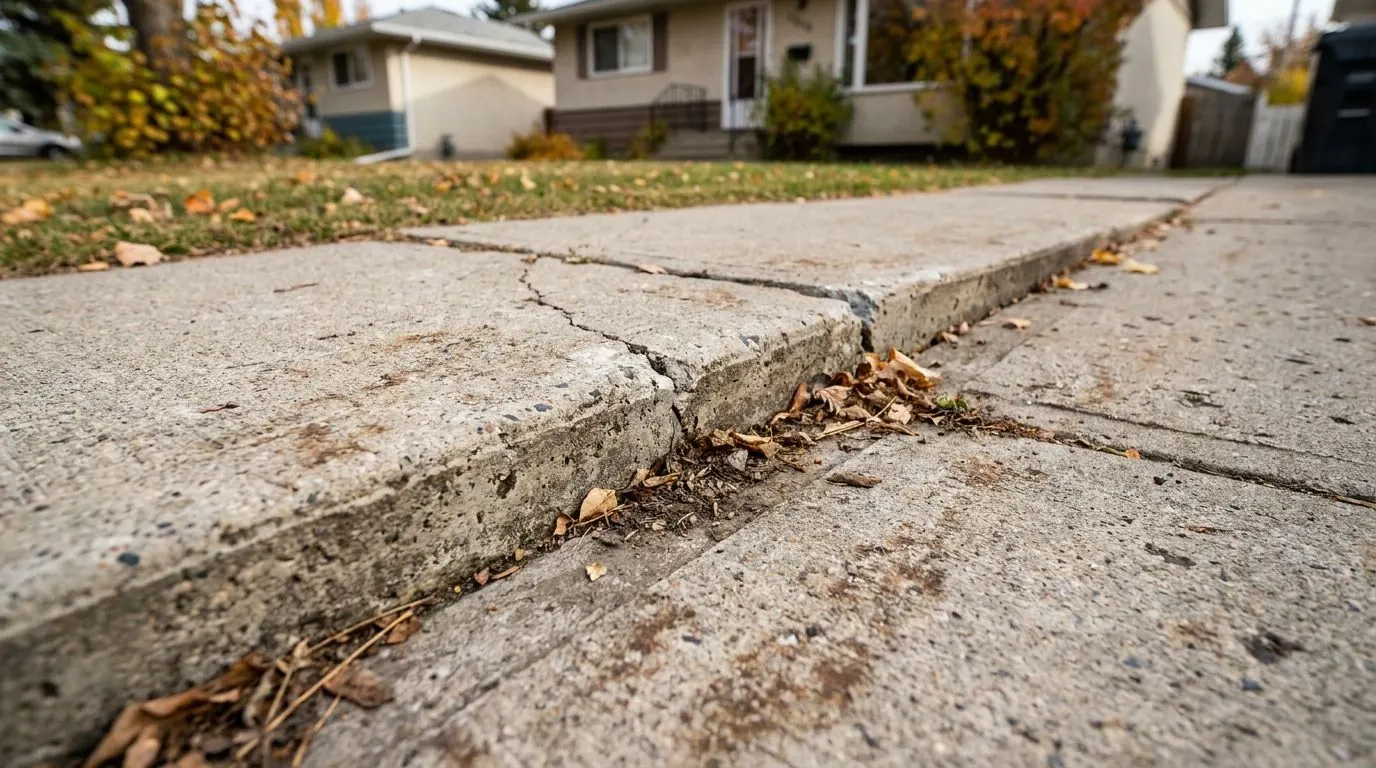
Start with what a flatwork slab is, because it explains everything that follows. A garage pad, driveway, walkway or patio has no footings and no piles. It is a plate of concrete resting on the ground, and the ground is its entire support system. When that ground loses volume the slab has nothing to span to, so it follows the soil down or cracks and drops on one side.
The soil loses volume for ordinary reasons. Backfill against a foundation keeps consolidating for years, which is why the slab next to the house is so reliably the one that drops. Water off a downspout washes fines out from underneath, and a service trench backfilled loose settles along its length. Clay shrinks in a dry season. Frost lifts a slab in winter and does not always put it back.
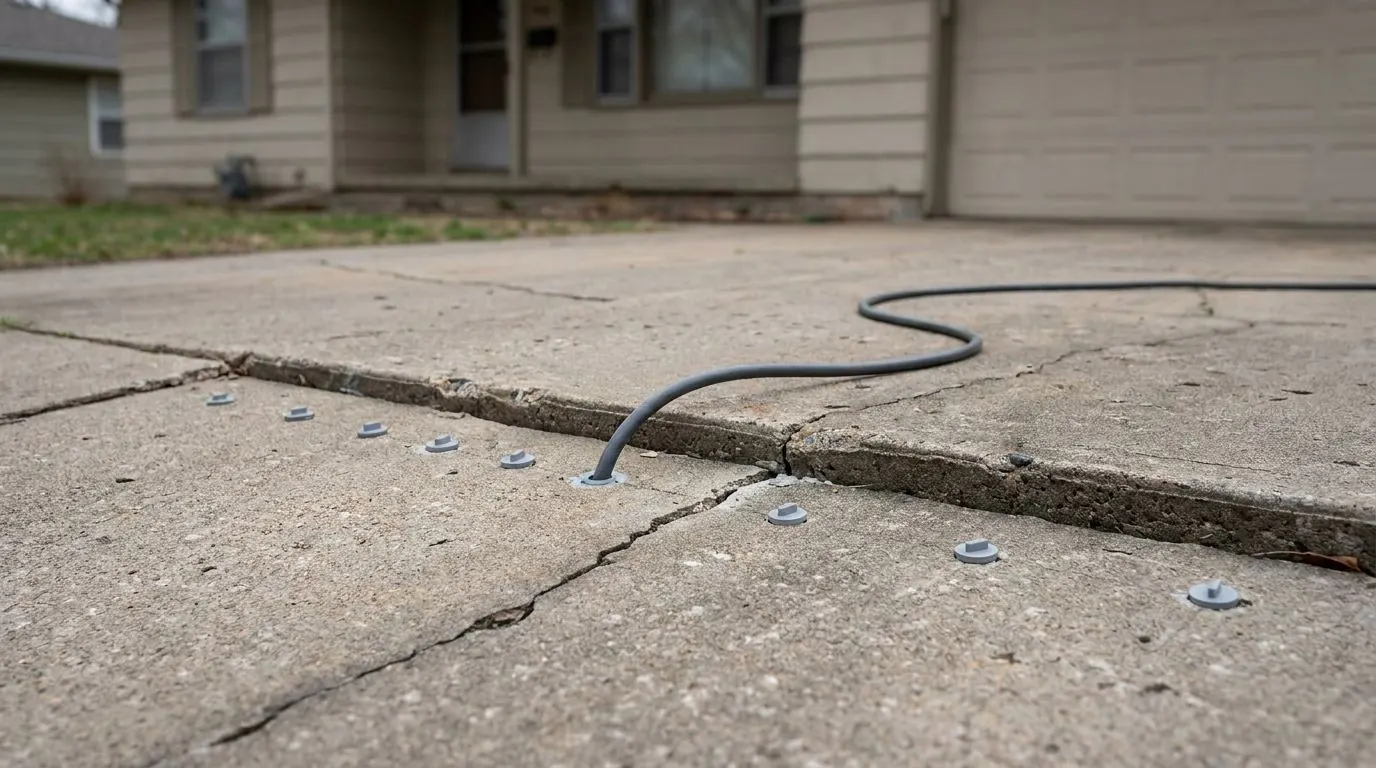
Slab jacking treats the void. Small holes are drilled through the slab and fill material is injected under pressure until the concrete returns to the intended elevation. It is worth being blunt: this is not piling. Nothing is driven, nothing bears in competent strata, no load is transferred to depth, and there is no torque log at the end of it. That states its limit: filling a void addresses the space, not the reason it appeared. If the slab is moving because a footing beneath it is settling, because clay under it is heaving, or because a water source is still running, the injection raises the concrete and the concrete moves again.
How the job runs
Different equipment and a different kind of day. No drive head, no excavation, no bracket. A hole pattern is laid out to suit the slab's joints and where the void is believed to be; ports go in and material is pumped. The lift is watched at the surface as it happens, at the joints against every adjoining slab, step and apron, since those neighbours define the target elevation. Injection is deliberately incremental: pushing hard through one port is the classic way to crack a slab you were hired to save.
Holes are patched when the lift is finished. Because nothing is formed and no fresh concrete placed, the wait before the slab carries traffic is the injected material's set, not a concrete cure. One thing to be clear about at the outset: existing cracks stay. Lifting a cracked slab lifts the pieces, and the crack can end up marginally more visible. You are buying elevation, not a new surface.
What decides the spec
Whether a slab can be lifted at all is decided by the slab, not the void. Thickness, whether it was reinforced, and the existing crack pattern determine whether it rises as a plane or as separate pieces. An unreinforced pad already broken into sections lifts as those sections, and you get level pieces with the joints still between them. That assessment happens before anyone quotes.
The rest is void size, which sets how much material goes in, plus what the slab has to match at its edges. A garage pad meets an apron and a door track; a walkway meets steps and a threshold. Those fixed neighbours set that elevation more firmly than the original grade does. What lies beneath — buried services, a sub-slab drain, a vapour barrier — has to be established before the first hole is drilled.
Areas We Serve for Slab Jacking & Concrete Lifting
We provide slab jacking & concrete lifting across Calgary and area. Ground conditions and permitting authority differ by community — pick yours for the local detail.
City of Calgary
Quote in 48 hours
City of Airdrie
Quote in 48 hours
Rocky View County
Quote in 48 hours
Foothills County
Quote in 48 hours
City of Chestermere
Quote in 48 hours
Wheatland County
Quote in 48 hours
Foothills County
Quote in 48 hours
Rocky View County
Quote in 48 hours
Slab Jacking & Concrete Lifting in practice
Frequently Asked Questions about Slab Jacking & Concrete Lifting
How deep do screw piles need to go in Alberta?
Are screw piles cheaper than concrete?
What are the downsides of screw piles?
Can screw piles be installed in winter?
Need Slab Jacking & Concrete Lifting?
Chinook Piling installs engineered screw pile foundations across Calgary and the surrounding communities. Call us today for a free estimate or to schedule service.