Basement Wall Anchors & Tiebacks in Calgary
Helical tieback anchors for basement walls bowing or leaning under lateral earth pressure. Each anchor is driven horizontally through the wall into competent soil beyond the failing wedge and torqued to a design capacity, so the wall is held by ground that is not moving.
Our Basement Wall Anchors & Tiebacks Process
Every job follows a clear, proven process so you know exactly what to expect from start to finish.
Quote
Send dimensions or drawings. Most quotes come back inside 48 hours.
Site visit
We confirm access, soil expectations and layout before scheduling.
Engineering
Stamped drawings and load calculations where the permit requires them.
Install
Piles driven to engineered torque. Most residential jobs take half a day.
Torque log
You receive the torque record, verified capacity and as-built documentation.
What basement wall anchors & tiebacks actually involves
Every other service here deals with vertical load — weight going down through a footing into soil. This one does not. A bowing basement wall is a horizontal problem: the soil outside pushes sideways harder than the wall was built to resist, and the wall bends inward. Nothing is sinking. That force acts at right angles to everything else we do, and it changes the diagnosis, the hardware and the job.
A foundation wall resists the push by spanning between the basement floor and the framing above. Its capacity is finite, and several things around Calgary eat into it. High-plasticity clay swells as it takes on water and presses directly on the wall; saturated backfill adds hydrostatic pressure on top of the earth pressure. Freeze and thaw pushes further each time, and a chinook belt delivers that cycle many times in one winter rather than once. The symptoms are characteristic: a horizontal crack near mid-height along a mortar joint, stair-step cracking toward the corners, inward deflection against a plumb line.
There are only two places to get resistance — the house, or ground beyond the soil doing the pushing. Carbon fibre and steel braces take the first route. Helical tiebacks take the second: an anchor is driven horizontally out through the wall, past the failing soil wedge, into ground that is not moving. Four methods are accepted: carbon fibre, steel braces, helical anchors, excavation and rebuild. We do anchors only — not carbon fibre, not rebuild, not drainage.
How the job runs
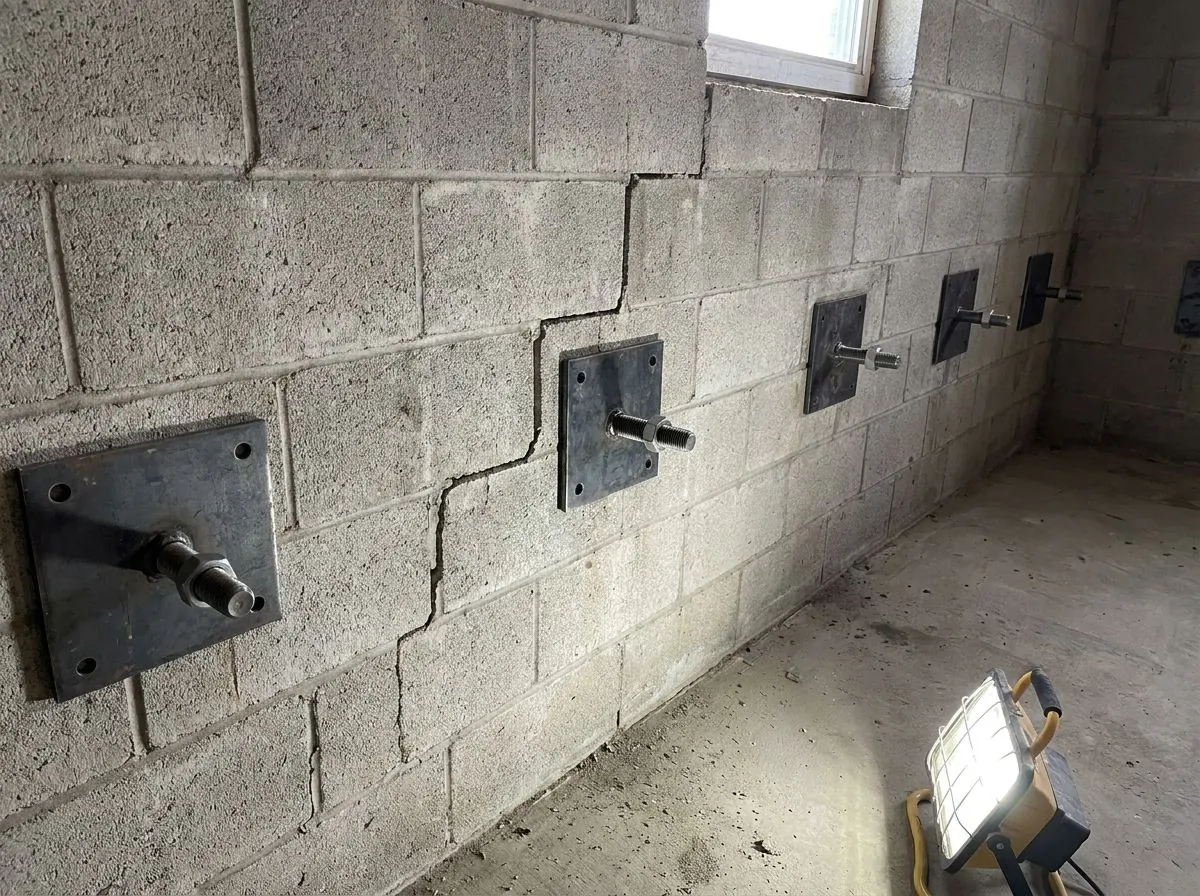
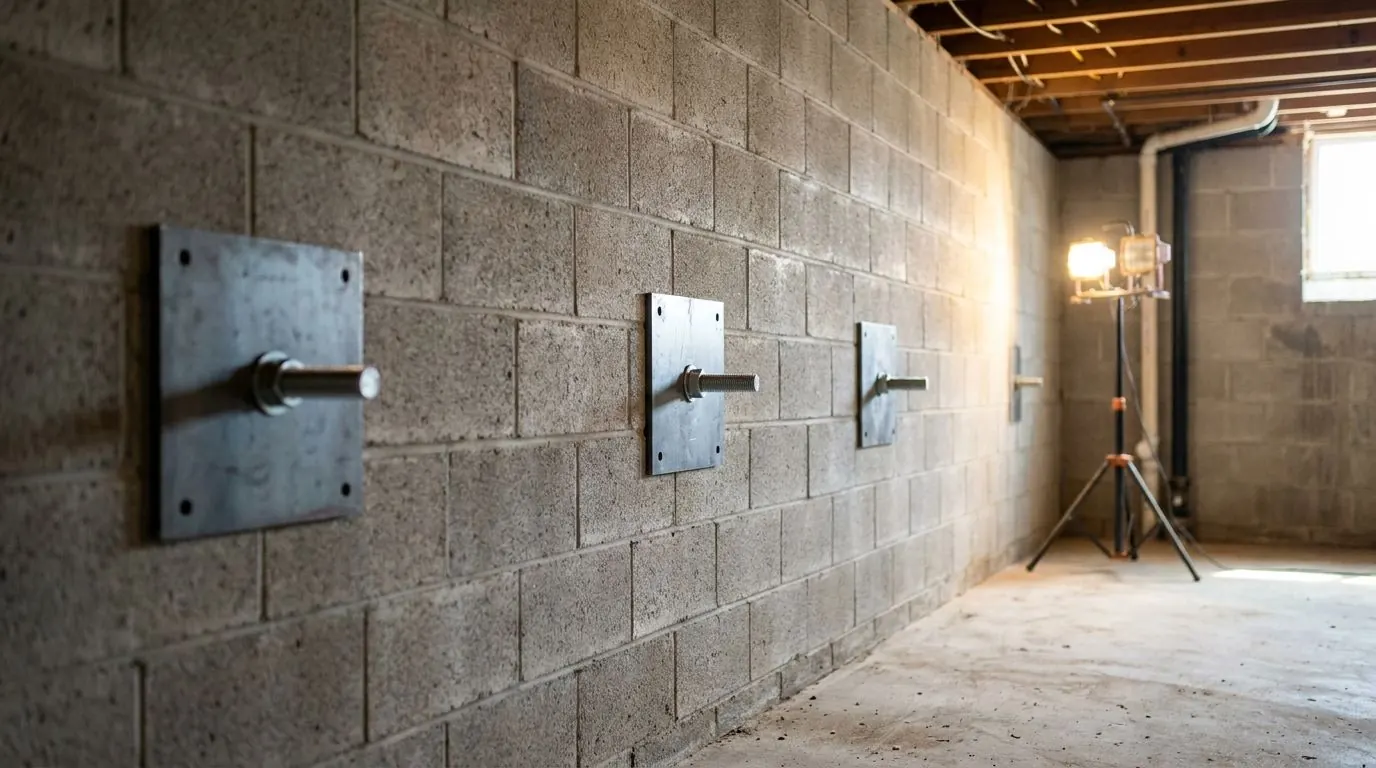
This is the only installation we do that runs sideways. Positions are set out inside and located outside, a penetration is made through the wall, and the anchor is advanced horizontally on a shallow line, torqued as it goes, until the helix bears well beyond the failing wedge. A rod comes back through the wall and a plate and nut on the inside face take the tension. What this job needs that nothing else here needs is yard: the reach to stable ground is set by the geometry of the wedge, not by preference.
Two outcomes are possible, and which one is agreed before we start. Holding means tensioning enough to arrest movement and leaving the wall in its current shape. Recovery means tightening incrementally over weeks or months to draw the wall back toward plumb. Recovery is frequently achievable and never guaranteed, so what we put in writing is stabilisation, with recovery as the intended outcome rather than the promise.
What decides the spec
Anchor count and spacing come out of the length of wall affected, the height of soil retained, how the wall is built, and an estimate of the lateral pressure. Wall type matters more here than anywhere else in our work: a block wall hinges at a bed joint and concentrates the problem on one line, while a poured wall distributes it. Window openings, beam pockets and buried services then constrain where an anchor can physically go.
The wall plate is its own decision. It hands all that tension back into masonry that has already proven it can be over-stressed, so plate size — and whether a spreader is needed — is set by what the wall can take at a point. This is structural repair to a foundation wall, so expect an APEGA-stamped design where the permit calls for one.
Areas We Serve for Basement Wall Anchors & Tiebacks
We provide basement wall anchors & tiebacks across Calgary and area. Ground conditions and permitting authority differ by community — pick yours for the local detail.
City of Calgary
Quote in 48 hours
City of Airdrie
Quote in 48 hours
Rocky View County
Quote in 48 hours
Foothills County
Quote in 48 hours
City of Chestermere
Quote in 48 hours
Wheatland County
Quote in 48 hours
Foothills County
Quote in 48 hours
Rocky View County
Quote in 48 hours
Basement Wall Anchors & Tiebacks in practice
Frequently Asked Questions about Basement Wall Anchors & Tiebacks
How deep do screw piles need to go in Alberta?
Are screw piles cheaper than concrete?
What are the downsides of screw piles?
Can screw piles be installed in winter?
Need Basement Wall Anchors & Tiebacks?
Chinook Piling installs engineered screw pile foundations across Calgary and the surrounding communities. Call us today for a free estimate or to schedule service.