Engineering & Pile Load Testing in Calgary
Torque-to-capacity correlation against CCMC-evaluated capacity tables, pile load testing, APEGA-stamped drawings, as-built certification and custom fabrication.
Our Engineering & Pile Load Testing Process
Every job follows a clear, proven process so you know exactly what to expect from start to finish.
Quote
Send dimensions or drawings. Most quotes come back inside 48 hours.
Site visit
We confirm access, soil expectations and layout before scheduling.
Engineering
Stamped drawings and load calculations where the permit requires them.
Install
Piles driven to engineered torque. Most residential jobs take half a day.
Torque log
You receive the torque record, verified capacity and as-built documentation.
What engineering & pile load testing actually involves
This is sold on its own because the proof is separable from the installation. Installation torque is the accepted field verification method for helical piles, but a reading is newton-metres until it is mapped onto capacity through a correlation somebody will defend. Everything here exists to make that mapping reviewable by an engineer of record, a building official or an inspector who was not on site.
The ordinary route is a CCMC evaluation report: the Canadian Construction Materials Centre evaluates a specific pile product against the National Building Code and publishes certified allowable capacities as a function of final installed torque. Tables are product-specific — the steel in the ground has to be the steel in the report — and evaluations expire. The registry is public and checkable in a minute, which is why this site links it rather than quoting report numbers: numbers given to us by suppliers have failed that check more than once.
Where the design sits outside those tables — demand above the published range, a helix arrangement not covered, soils the correlation was never calibrated for — the answer is a site-specific load test interpreted by an APEGA-licensed P.Eng., not an extrapolation.
How the job runs
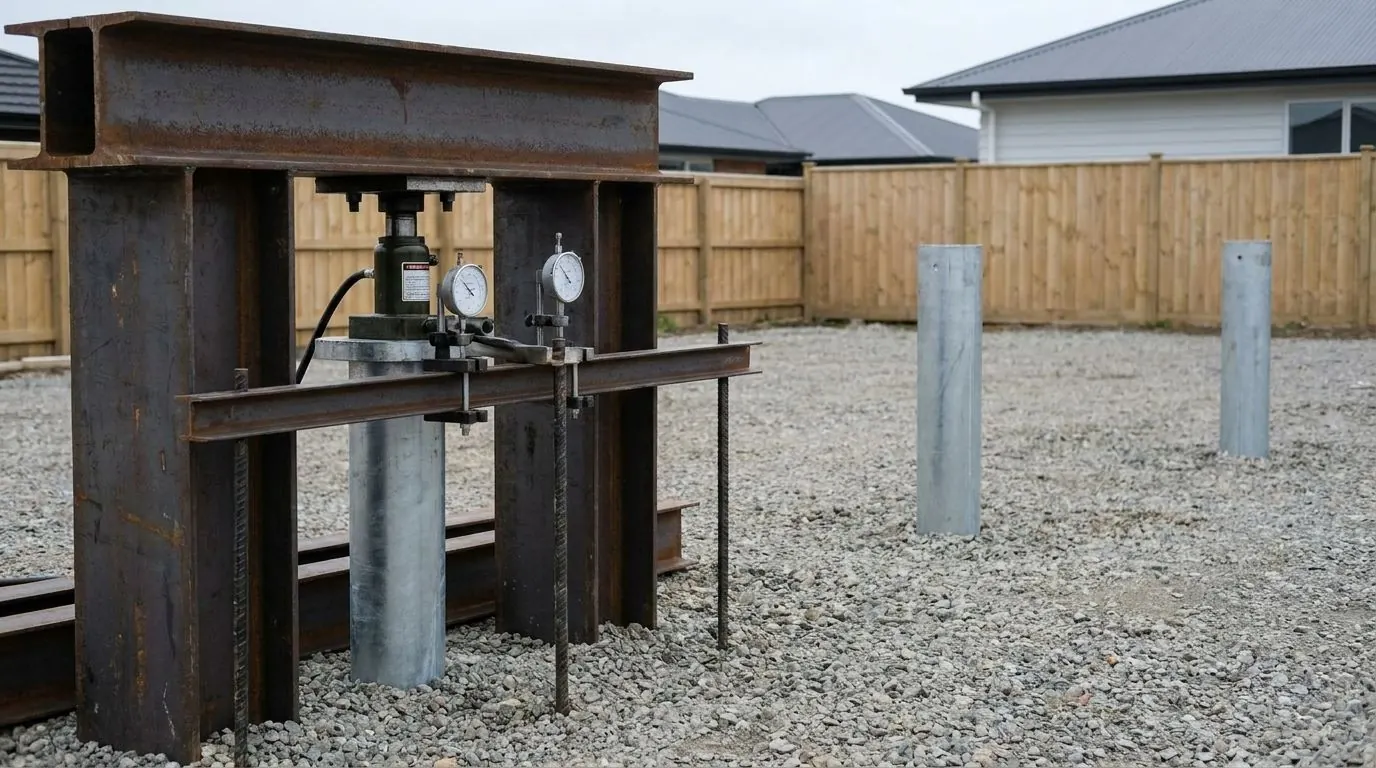
A load test is a controlled experiment. The pile is loaded by a hydraulic jack reacting against a frame on reaction piles or anchors set far enough away that their influence zones do not overlap the test pile; too close, and the reaction system stiffens the ground beneath and flatters the result. Load is measured on a calibrated load cell, not inferred from jack pressure; displacement is read from dial gauges or LVDTs on a reference beam founded clear of both zones. Load goes on in increments and off in decrements, with rebound recorded. The deliverable is a load-displacement curve and an interpreted capacity with the criterion named, because different criteria read different numbers off one curve.
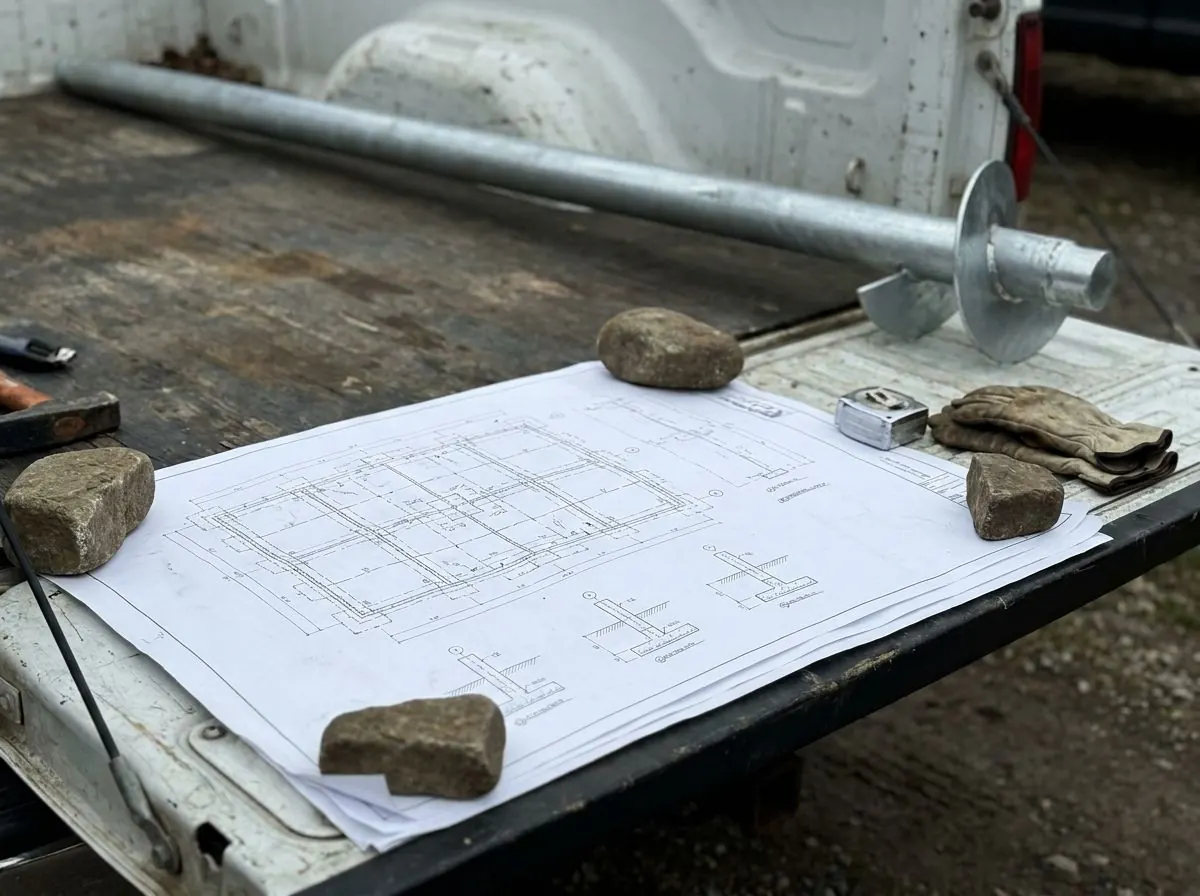
The documentation runs on a longer arc than the test. It begins with a review of the pile schedule against the geotechnical report, so a mismatch is caught on paper before anything is installed, and continues through APEGA-stamped drawings, per-pile torque records and as-built positions. It closes with a field review letter where the authority having jurisdiction requires one. Where we test piles somebody else installed, we say so on the record and report what was measured, including where it falls short.
What decides the spec
The test programme is defined by a few decisions that belong before mobilisation. How many tests: a proportion of production piles, or sacrificial piles installed ahead of production while the design can still be adjusted. Which direction — compression, tension or lateral — against the governing load case rather than by habit. What magnitude, as a multiple of design load. What acceptance criterion, stated explicitly. And how much reaction capacity is available, since the reaction system often caps the load before the pile does.
The ratio between torque and capacity is a function of shaft geometry — narrower shafts carry a higher ratio than wide ones — not a universal constant recalled from memory. It comes from the evaluation report or the test, and the source belongs in the documentation. Torque from a calibrated head with a current record is evidence; torque inferred through an uncalibrated hydraulic system is an estimate.
Areas We Serve for Engineering & Pile Load Testing
We provide engineering & pile load testing across Calgary and area. Ground conditions and permitting authority differ by community — pick yours for the local detail.
City of Calgary
Quote in 48 hours
City of Airdrie
Quote in 48 hours
Rocky View County
Quote in 48 hours
Foothills County
Quote in 48 hours
City of Chestermere
Quote in 48 hours
Wheatland County
Quote in 48 hours
Foothills County
Quote in 48 hours
Rocky View County
Quote in 48 hours
Engineering & Pile Load Testing in practice
Frequently Asked Questions about Engineering & Pile Load Testing
How deep do screw piles need to go in Alberta?
Are screw piles cheaper than concrete?
What are the downsides of screw piles?
Can screw piles be installed in winter?
Need Engineering & Pile Load Testing?
Chinook Piling installs engineered screw pile foundations across Calgary and the surrounding communities. Call us today for a free estimate or to schedule service.