Industrial & Oilfield Piling in Calgary
Helical foundations for compressor stations, pipe racks, wellhead and header supports, substations, tanks and remote-access sites.
Our Industrial & Oilfield Piling Process
Every job follows a clear, proven process so you know exactly what to expect from start to finish.
Quote
Send dimensions or drawings. Most quotes come back inside 48 hours.
Site visit
We confirm access, soil expectations and layout before scheduling.
Engineering
Stamped drawings and load calculations where the permit requires them.
Install
Piles driven to engineered torque. Most residential jobs take half a day.
Torque log
You receive the torque record, verified capacity and as-built documentation.
What industrial & oilfield piling actually involves
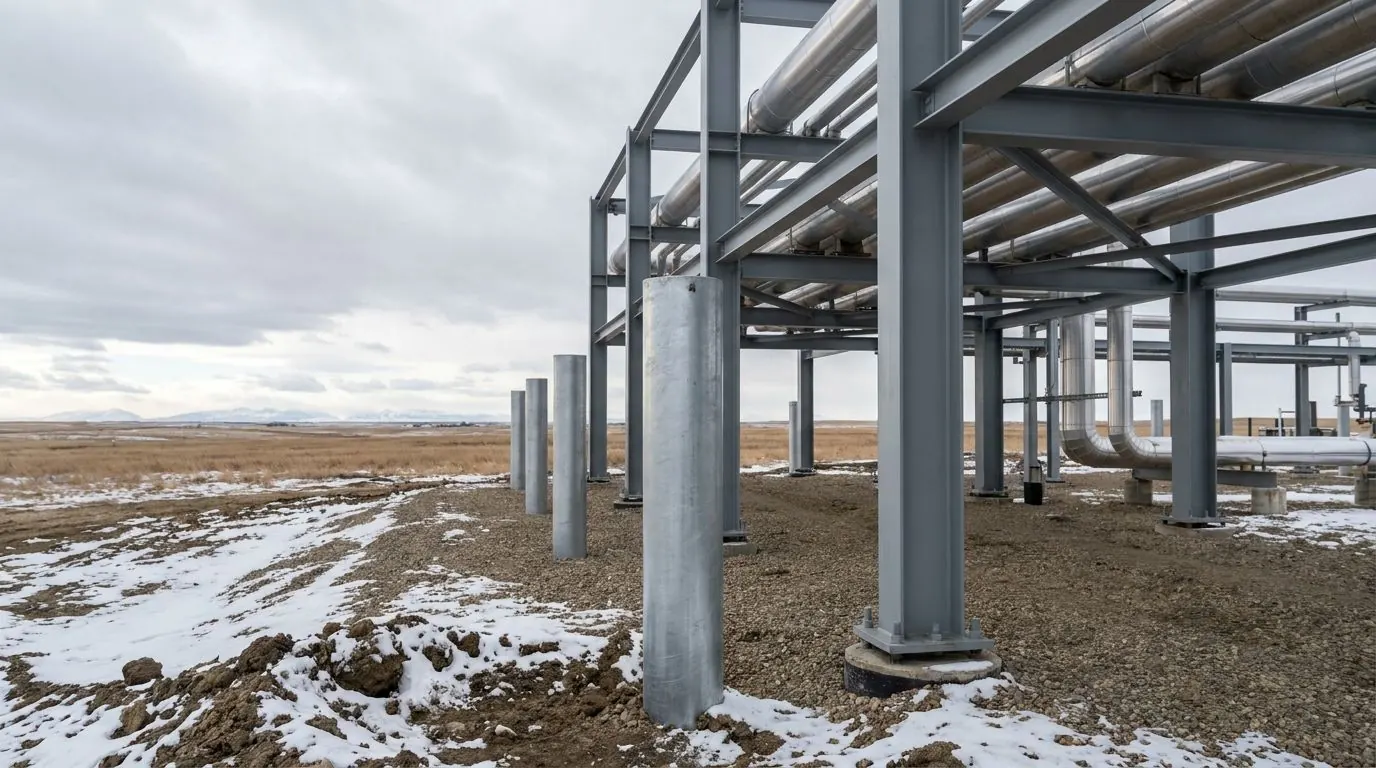
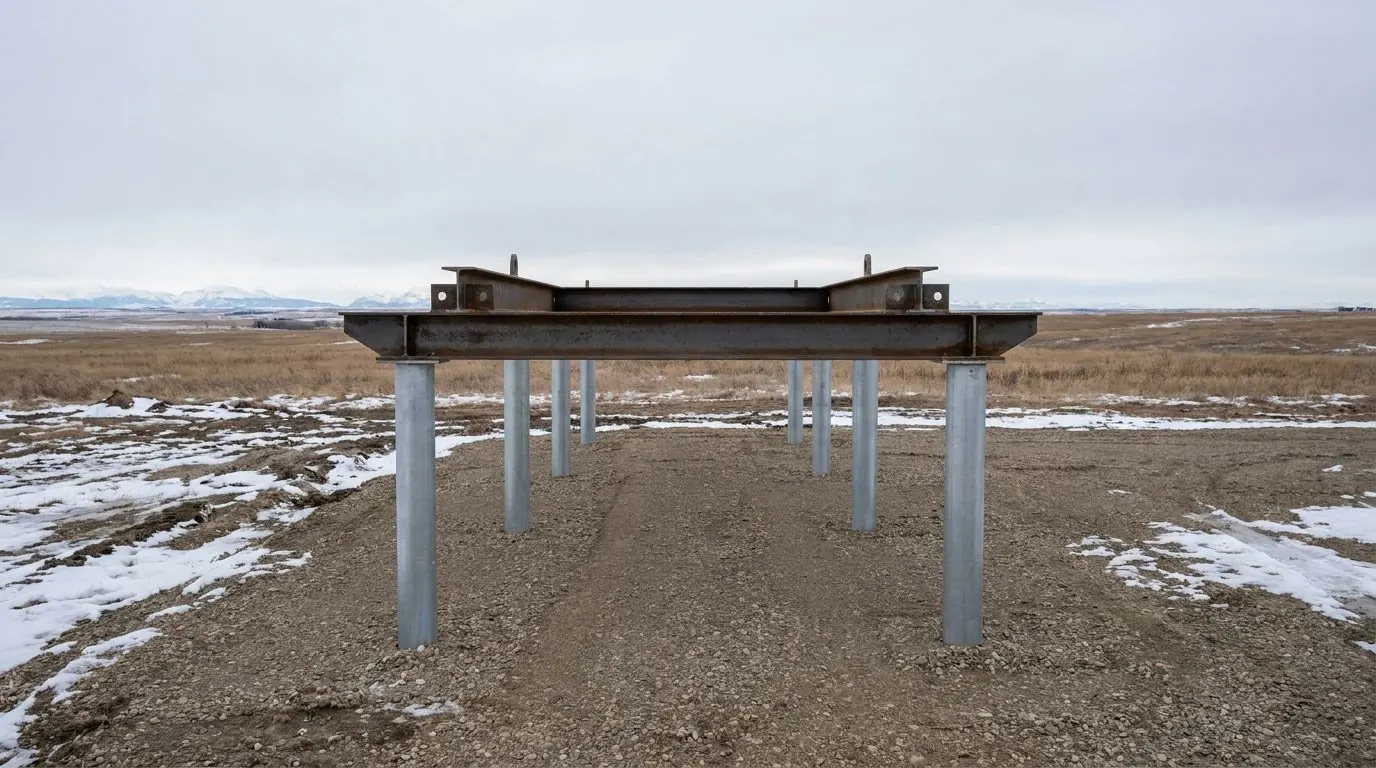
On an industrial or oilfield site the piling is rarely the hard part. Pump jack bases, equipment and compressor skids, pipe racks and sleepers, wellhead and header supports, metering stands, tank and shelter platforms — the engineering is well trodden and the loads are modest by industrial standards. What decides whether a contractor can do the work is whether they can get onto the lease at all: prequalification status, safety documentation, orientation, competency records and a prime contractor determination, all ahead of the first pile.
Check the gate before the bid, because procurement people are tired of finding out at the audit. If your prequalification needs a current COR number or an active account in a particular portal, ask us about it directly before issuing a bid package.
The rest is logistics rather than compliance. Leases are remote, roads seasonal, ground often soft or reclamation-sensitive, and the access window is frequently the binding constraint. A helical crew is small and self-contained — a carrier, a drive head, an operator and steel — with no concrete truck to route in and nothing to cure.
How the job runs
Almost all of it happens before anyone mobilises. Prime contractor is determined in writing. A site-specific hazard assessment and job safety analyses are written for the actual scope rather than pulled off a shelf. Orientation is completed to the operator's system, whatever it is. Ground disturbance permits, locates including operator-owned lines, crossing agreements and work permits close out before steel arrives. Where a site's classification calls for tickets or monitoring we do not carry, we say so and either arrange it or decline the scope.
On the ground the sequence bends around access rather than weather. Matting is planned for soft ground and for surfaces where rutting is itself the liability, and winter access is often easier than summer because frozen ground carries a machine that muskeg will not. Torque is logged per pile and correlated to capacity, and the record is handed over rather than described. With no cure, a millwright can set the skid behind us the same day, which is why helicals appear on turnaround schedules. At end of life the piles come out and the steel is recoverable.
What decides the spec
Uplift, reversal and lateral demand usually govern rather than dead load. A pump jack applies a cyclic, reversing load through its base. A pipe rack has to be resolved into guide bays and anchor bays, because thermal movement in the line puts longitudinal thrust into particular supports and not others. Wind on a tall, light stand can outweigh everything the structure carries. A rack designed as though every bay were identical is a rack that moves at the anchor.
Corrosion and clearance drive the rest. Where the geotechnical or environmental work reports saline soils, resistivity concerns or produced-water spills, the coating system and a sacrificial wall allowance belong in the specification explicitly, with a design life stated. Spacing is often set by the buried pipe corridor rather than by soil mechanics, since clearance from live piping can rule out the location the drawing wanted.
Areas We Serve for Industrial & Oilfield Piling
We provide industrial & oilfield piling across Calgary and area. Ground conditions and permitting authority differ by community — pick yours for the local detail.
City of Calgary
Quote in 48 hours
City of Airdrie
Quote in 48 hours
Rocky View County
Quote in 48 hours
Foothills County
Quote in 48 hours
City of Chestermere
Quote in 48 hours
Wheatland County
Quote in 48 hours
Foothills County
Quote in 48 hours
Rocky View County
Quote in 48 hours
Industrial & Oilfield Piling in practice
Frequently Asked Questions about Industrial & Oilfield Piling
How deep do screw piles need to go in Alberta?
Are screw piles cheaper than concrete?
What are the downsides of screw piles?
Can screw piles be installed in winter?
Need Industrial & Oilfield Piling?
Chinook Piling installs engineered screw pile foundations across Calgary and the surrounding communities. Call us today for a free estimate or to schedule service.