Sonotubes in Calgary: What a Poured Deck Footing Actually Costs You
A Sonotube costs less than lunch. That is the appeal, and it is real — as a material, a cardboard form is close to free compared with anything else that ends up holding a deck.
The tube is not the cost. It is the cheapest line on a list that has several other lines, and the ones people forget are the ones that hurt.
What a poured footing actually involves
For each footing on a Calgary deck you are looking at a hole that reaches below frost, and frost here penetrates well over a metre in a normal winter. So per footing:
- Dig the hole, by hand or with a rented auger. Clay does not auger pleasantly, and cobbles stop a small auger dead.
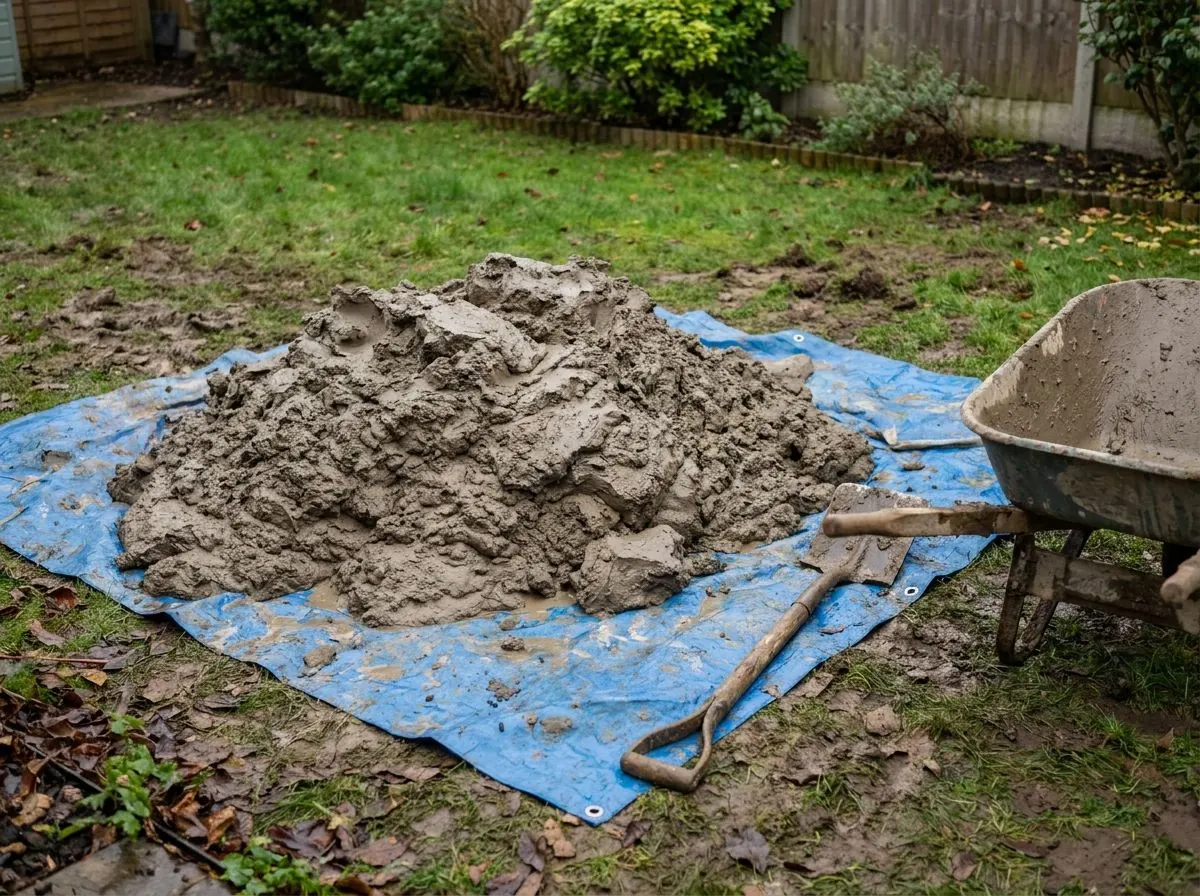
- Get the spoil out of the yard. A dozen holes of that depth is a real volume of clay, and it has to go somewhere that is not your lawn.
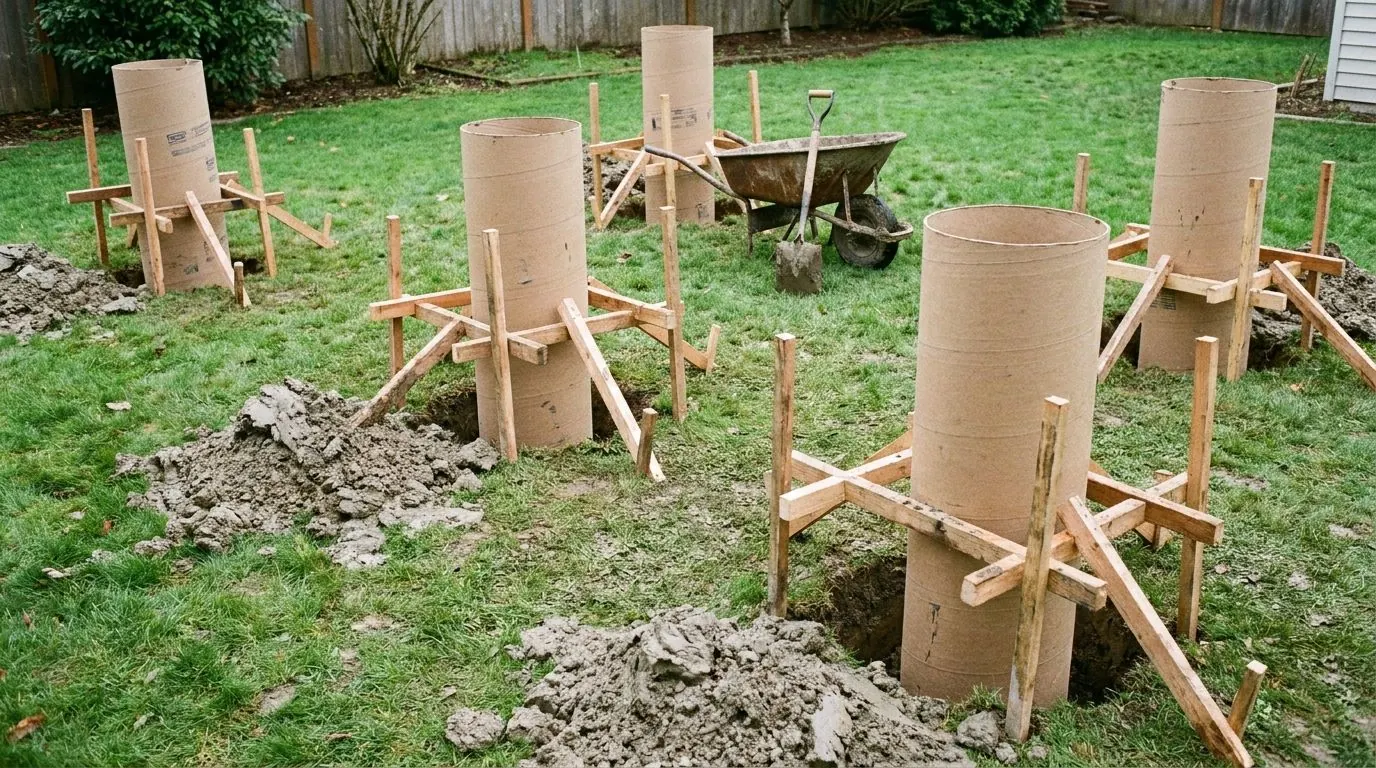
- Set and brace the tube plumb, backfill around it so it does not float or drift.
- Fill it. Bagged mix for a few, ready-mix if there are many, and a wheelbarrow route through a gate that was not designed for one.
- Wait. Concrete needs to cure before you load it.
- Set anchors or saddles while it is wet, in the right place, at the right height, or fix it later with epoxy anchors.
None of that is difficult. All of it is time, and most of it is the part that does not appear when you price a tube.
Where poured footings go wrong here
Three failure modes we see often enough to name.
Not actually below frost. The hole gets dug to where digging got hard rather than to where it needed to be. Clay and cobbles make that a very tempting place to stop. A footing that bears above frost depth will lift, and it will lift unevenly across a deck.
Blowouts and bells. A tube braced only at the top can bulge or shift when filled. In wet clay a hole can slough in and you end up pouring considerably more concrete than you planned into a shape you cannot see.
Concrete alone is not capacity. A poured pier transfers load to whatever it is bearing on. If that is soft or disturbed material, the pier is a very solid object sitting on something that is not. Nothing about the pour tells you which situation you are in. This is the part people find counterintuitive: you can do everything right with the concrete and still have a footing that settles.
Where poured footings genuinely win
This is not a piece arguing that nobody should pour concrete.
If you are doing three footings for a small landing, you own a shovel, and you have somewhere to put the spoil, pouring is cheap and completely reasonable. Concrete also wins where you need a broad bearing surface rather than a point — a slab-on-grade, a monolithic pad, a grade beam that has to distribute load along its length.
And there are sites where a machine simply cannot get in and hand-digging is the only option left. We will tell you when that is the case.
How the comparison actually breaks down
Not tube versus pile. Total installed foundation versus total installed foundation:
| Poured in Sonotube | Screw pile | |
|---|---|---|
| Below frost | If the hole is deep enough | Driven until torque confirms it |
| Excavation | A hole per footing | None |
| Spoil | Yes, and it has to leave | None |
| Cure before loading | Days | None — frame the same day |
| Weather window | Cannot pour into frozen ground easily | Year-round |
| Capacity | By design, assumed on site | Measured at every pile |
| Documentation | None by default | Torque log per pile |
The line that matters most for a homeowner is the cure time, because it is the one that decides whether your deck build is one weekend or three. The line that matters most to an engineer is the last one: with a pile, capacity is a number that was recorded, not an assumption that was made.
What it costs
We are not going to print a per-footing figure here, because we do not publish prices we have not verified against real quotes, and a made-up comparison would be worse than none.
What we will tell you is where the money actually goes, because that is the part people get wrong. On a poured job, the tube and the concrete are the small numbers. The large ones are labour hours, machine rental, spoil disposal, and the days between digging and framing. On a pile job, the steel and the install are essentially the whole number, and there is no second visit.
Price both properly — full installed cost, spoil removal included, and the calendar days each option costs you — and the answer is usually clear without anyone needing to sell you anything.
If you have already dug
You are not stuck. Screw piles do not need the holes you have dug, and a partly dug job is a common reason people call. It is worth a conversation before you order concrete rather than after.
Worth reading next: how deep piles actually go here, screw piles versus concrete on cost, and how many a deck needs.
Send us the deck dimensions and we will tell you what it needs — including when pouring is the sensible call.
Need a foundation quote?
If you have a question about a foundation or want a quote, our team is ready to help. We serve Calgary and the surrounding communities.