What Are Screw Piles? A Plain Explanation
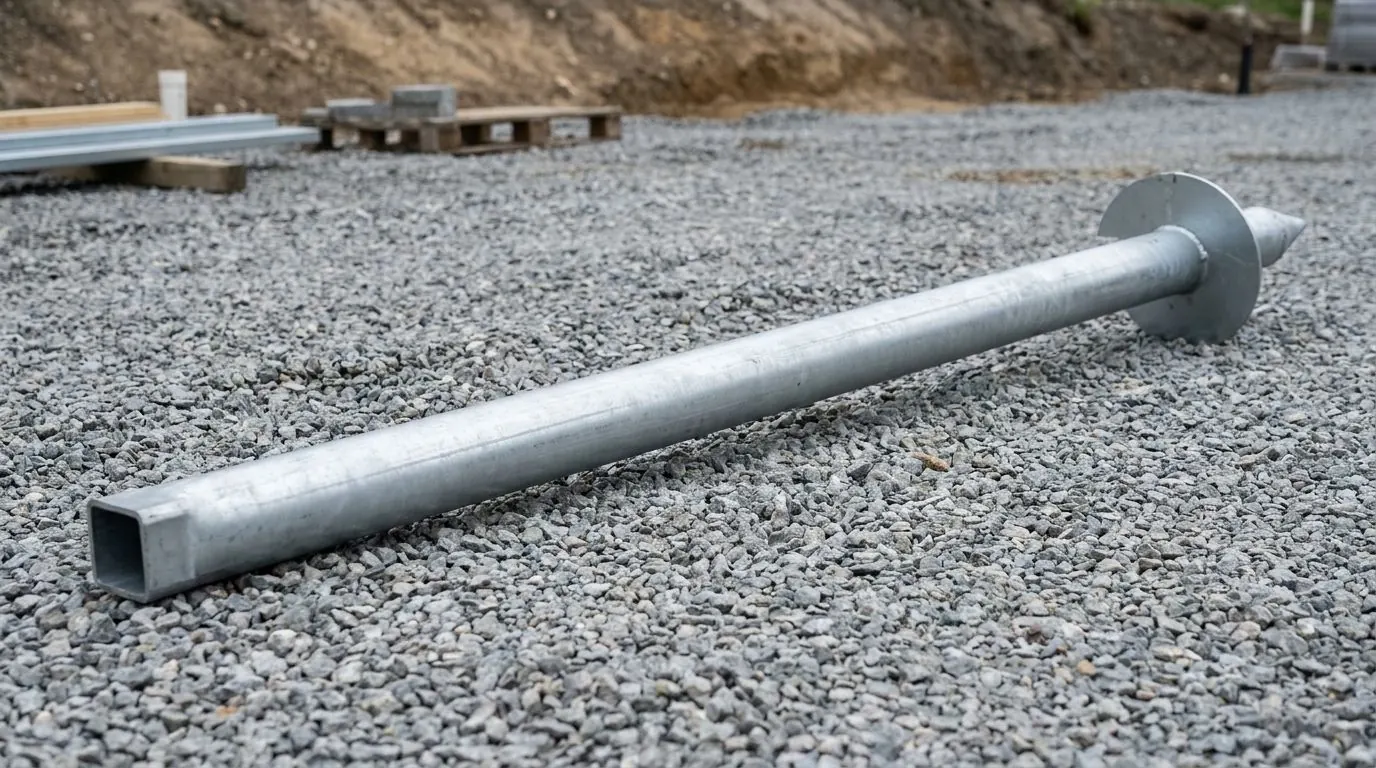
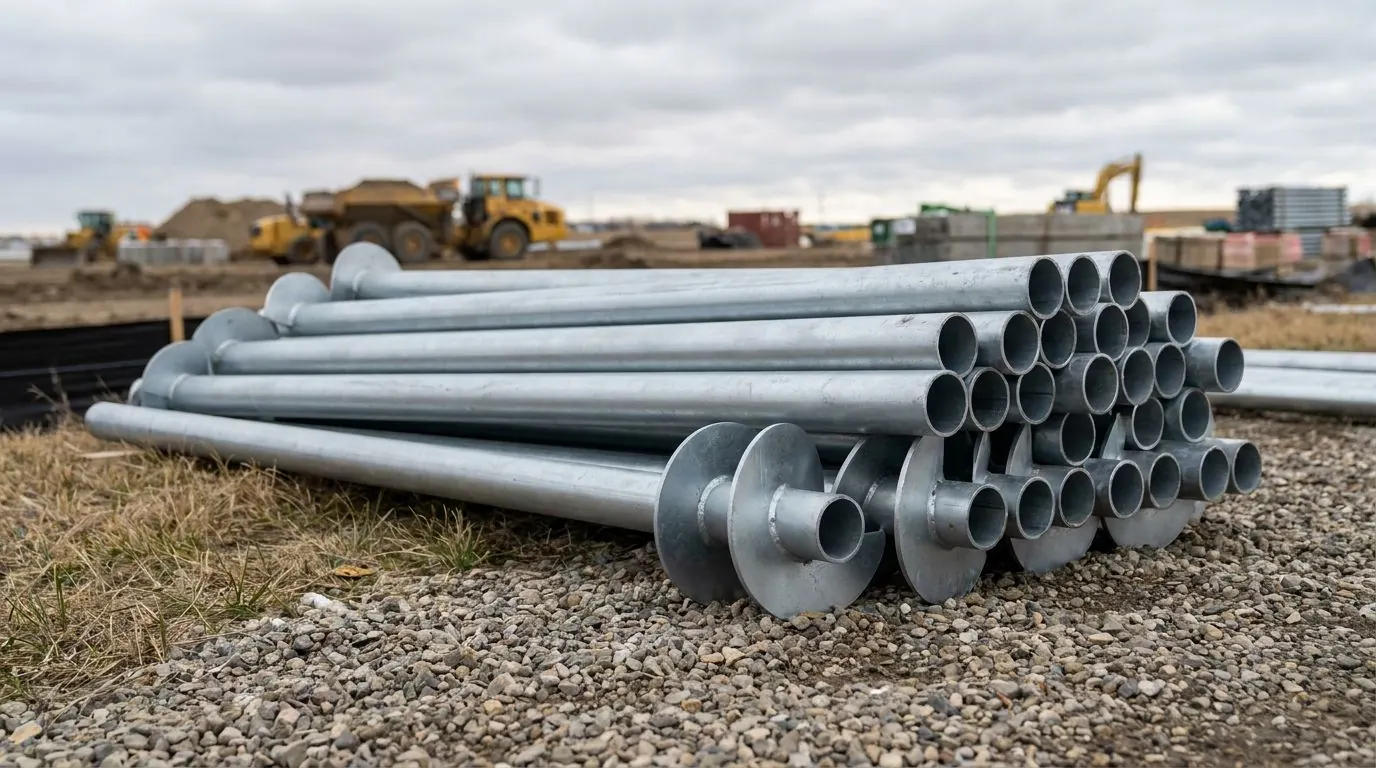
A screw pile is a steel shaft with one or more helical plates welded near the bottom. It is rotated into the ground by machine — genuinely screwed in, like a giant wood screw — until it reaches soil capable of carrying the load. A bracket at the top takes whatever you are building.
That is the whole idea. Everything else is detail.
Screw pile, helical pile, helical pier — what’s the difference?
Nothing meaningful. They are the same product under three names.
- Screw pile is the common term in Canada, and by some margin the most used here
- Helical pile is the more technical term, common in engineering documents
- Helical pier is more common in the United States, often in foundation repair contexts
If a quote uses one and a drawing uses another, they are talking about the same thing.
How they carry load
Two mechanisms working together:
End bearing. The helix presses down on the soil beneath it, the way a footing does — just much deeper, on better ground.
Shaft friction. The soil grips the shaft along its length, adding capacity.
The helix also resists uplift, which is the direction of load that expansive clay and wind apply. In Alberta that often matters as much as the downward load.
How deep do they go?
Until torque says they are deep enough — not to a fixed number.
As the pile advances, installation torque is measured, and torque correlates to bearing capacity. The pile is driven until it reaches the torque corresponding to the engineered load. In the Calgary area that is always at least below the frost line, which runs roughly 1.2 to 1.8 metres, and often considerably deeper.
Two piles on one site can finish at different depths and both be correct. We have written that up in full in how deep screw piles go in Alberta.
How long do they last?
Galvanized piles in typical soils are designed for service lives measured in decades, and manufacturers commonly quote 75 to 100 years for their systems.
Treat any single figure carefully. Service life is a design output depending on steel thickness, coating and how aggressive the soil is — not a fixed property of the product. In aggressive soils it needs designing for specifically.
What they get used for
Residential — decks, garages, home additions, sunrooms, garden suites, RTM and modular homes, hot tubs, sheds, fence and gate posts.
Foundation repair — underpinning settling footings, lifting and re-levelling structures, crawlspace support.
Commercial — grade beams, solar arrays, sign and light pole bases, EV charging infrastructure, boardwalks.
Industrial and oilfield — compressor stations, pipe racks, wellhead supports, substations, tanks, remote sites.
The same principle scales from a garden shed to a compressor station. What changes is shaft size, helix configuration and how much engineering sits behind it.
Why they suit this region
Three reasons that are specifically about Alberta:
Frost. Bearing below the frost line is the whole game here, and piles reach it without excavating to it.
Reactive clay. Calgary’s clay swells and shrinks with moisture. A pile anchored below the active zone is not part of that cycle.
Winter. Frozen ground stops concrete. It does not stop pile installation, so work continues through months when other foundations cannot be poured.
What they are not good for
Shallow bedrock, where there is nowhere useful for a helix to go. Structures wanting a continuous bearing surface rather than point loads. And very large pile counts on wide-open sites, where concrete economics start to win.
Full account in the downsides of screw piles.
What you should get with them
- A torque log, per pile
- The verified capacity that torque corresponds to
- Stamped engineering where the permit requires it
- An as-built showing final positions and depths
Without those you have steel in the ground and somebody’s word for it.
New to this and not sure what your project needs? Tell us what you are building — or start with what screw piles cost in Calgary.
Need a foundation quote?
If you have a question about a foundation or want a quote, our team is ready to help. We serve Calgary and the surrounding communities.